Airline Service Vector Infographic: Enhancing Visual Communication in Airport Security Presentations
In today's fast-paced travel industry, clear and efficient communication is essential—especially when it comes to airport security procedures. One of the most effective tools for simplifying complex processes is the Airline Service Vector Infographic. This type of visual aid helps professionals and travelers alike understand the multi-step security screening process through clean, scalable design elements and data visualization techniques.
Why Use a Vector Infographic for Airport Security Presentations?
Airport security involves a series of steps that must be followed precisely to ensure safety and compliance. Explaining these steps using traditional text-based methods can be overwhelming and less engaging. The Airline Service Vector Infographic offers a solution by transforming these procedures into a visually digestible format. With its use of icons, timelines, and process charts, this infographic template simplifies communication and improves comprehension across diverse audiences.
Vector graphics are especially useful because they maintain clarity at any size, making them ideal for both digital presentations and printed materials. Whether used in training sessions for airport staff or informational displays for passengers, vector-based infographics provide a scalable and professional look that enhances any presentation.
Understanding the Five-Step Data Visualization Approach
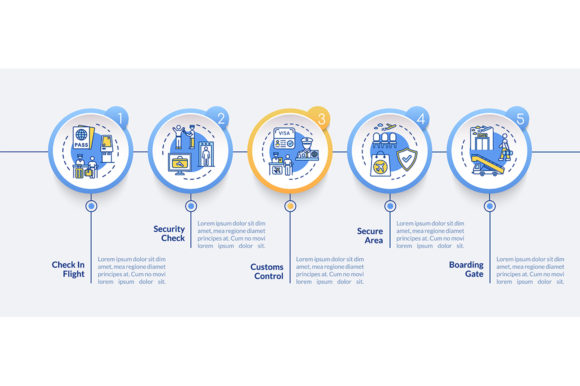
The core of the Airline Service Vector Infographic lies in its five-step data visualization model. Each step corresponds to a key phase in the airport security process, allowing viewers to follow along with ease. Here's how it typically breaks down:
- Check-in and Document Verification: This initial step involves confirming passenger identity and flight details, often including passport checks and boarding pass issuance.
- Baggage Screening: Luggage is scanned using advanced imaging technology to detect prohibited items before it's loaded onto the aircraft.
- Passenger Screening: Travelers walk through metal detectors or full-body scanners while security personnel monitor for anomalies.
- Secondary Screening: If initial scans raise concerns, passengers may undergo additional checks such as pat-downs or manual bag inspections.
- Boarding Clearance: After passing all security checkpoints, passengers receive final clearance to board their flights.
By mapping each phase visually, the infographic provides a structured yet engaging way to communicate these steps. This approach not only aids in learning but also helps reinforce standard operating procedures for airport personnel.
Process Timeline Charts and Workflow Layouts
Another key feature of the Airline Service Vector Infographic is the inclusion of a process timeline chart and workflow layout. These design elements allow presenters to illustrate the chronological flow of security procedures, making it easier to identify bottlenecks or areas for improvement.
The timeline chart is particularly useful for showing the duration and sequence of each step. For example, it can highlight how long the average passenger spends at each checkpoint, helping airport planners optimize staffing and resource allocation. Meanwhile, the workflow layout uses linear icons to represent each action, providing a minimalist yet informative visual guide.
These layouts are especially valuable in training materials, where consistency and clarity are crucial. By presenting information in a logical sequence, airport staff can better understand their roles and responsibilities within the broader security framework.
Design Elements That Make a Difference
The effectiveness of the Airline Service Vector Infographic also stems from its thoughtful use of design elements. These include:
- Linear Icons: Simple, scalable icons that represent each step of the security process, making the information easy to scan and understand.
- Color Coding: Assigning distinct colors to different stages helps differentiate between steps and enhances visual retention.
- Typography: Clear, legible fonts ensure that text remains readable even when projected on large screens or printed in small formats.
- Layered Information: Some templates allow for multiple layers of detail, enabling presenters to toggle between high-level overviews and more detailed breakdowns.
These design choices are not just aesthetic—they play a functional role in how information is absorbed and retained. Whether used in internal training sessions or public-facing presentations, these elements contribute to a more engaging and effective communication strategy.
Practical Benefits Across Industries
The Airline Service Vector Infographic isn't limited to airport security alone. Its adaptable design makes it useful in a variety of industries where process visualization is key. For instance, logistics companies can use it to explain cargo screening procedures, while event planners might repurpose it to outline entry protocols for large venues.
Additionally, educators and training professionals benefit from using these infographics to teach students about travel safety and compliance. Because the template is available in multiple formats—such as EPS and JPG—it can be easily integrated into digital learning platforms, printed handouts, or interactive presentations.
What’s Included in the ZIP File?
When downloading the Airline Service Vector Infographic template, users typically receive a ZIP file containing several key components:
- EPS File: Ideal for high-quality printing and professional design work, as it allows for full scalability without loss of resolution.
- JPG File: Perfect for quick digital use, such as embedding in presentations or sharing online.
- Editable Source Files: Some templates include editable versions compatible with design software like Adobe Illustrator or CorelDRAW, allowing for customization.
This versatility ensures that the infographic can be tailored to meet specific needs, whether for internal use or public distribution.
Choosing the Right Template for Your Needs
Not all vector infographics are created equal. When selecting a template, consider the following factors:
- Clarity: The design should be easy to follow at a glance, with well-organized steps and minimal clutter.
- Customizability: Look for templates that allow you to adjust colors, icons, and text to match your branding or specific use case.
- Compatibility: Ensure the file types are compatible with your preferred design or presentation software.
- Scalability: Vector formats like EPS are preferable for maintaining quality across different sizes and applications.
By selecting a high-quality template, you can ensure that your airport security presentation is both professional and impactful.
Integrating the Infographic into Modern Workflows
Today’s airports are increasingly reliant on digital tools to streamline operations and improve passenger experiences. The Airline Service Vector Infographic fits seamlessly into modern workflows by integrating with digital signage, mobile apps, and training platforms.
For example, airport kiosks can display the infographic to guide travelers through security checkpoints, reducing confusion and improving efficiency. Similarly, mobile apps can embed the infographic as part of a pre-flight checklist, helping passengers prepare for what to expect at the airport.
In internal operations, the infographic can be used as part of staff training modules or performance dashboards. By visualizing key steps and timelines, airport managers can identify inefficiencies and implement data-driven improvements.
Final Thoughts on Visual Communication in Airport Security
In an industry where clarity and compliance are paramount, the Airline Service Vector Infographic serves as a powerful tool for enhancing understanding and engagement. Whether used for training, public information, or internal operations, this type of visual aid simplifies complex procedures and supports more effective communication.
As airports continue to evolve and adopt new technologies, the need for clear, scalable visual tools will only grow. By leveraging the Airline Service Vector Infographic, professionals can ensure that critical security information is delivered accurately, efficiently, and memorably.